
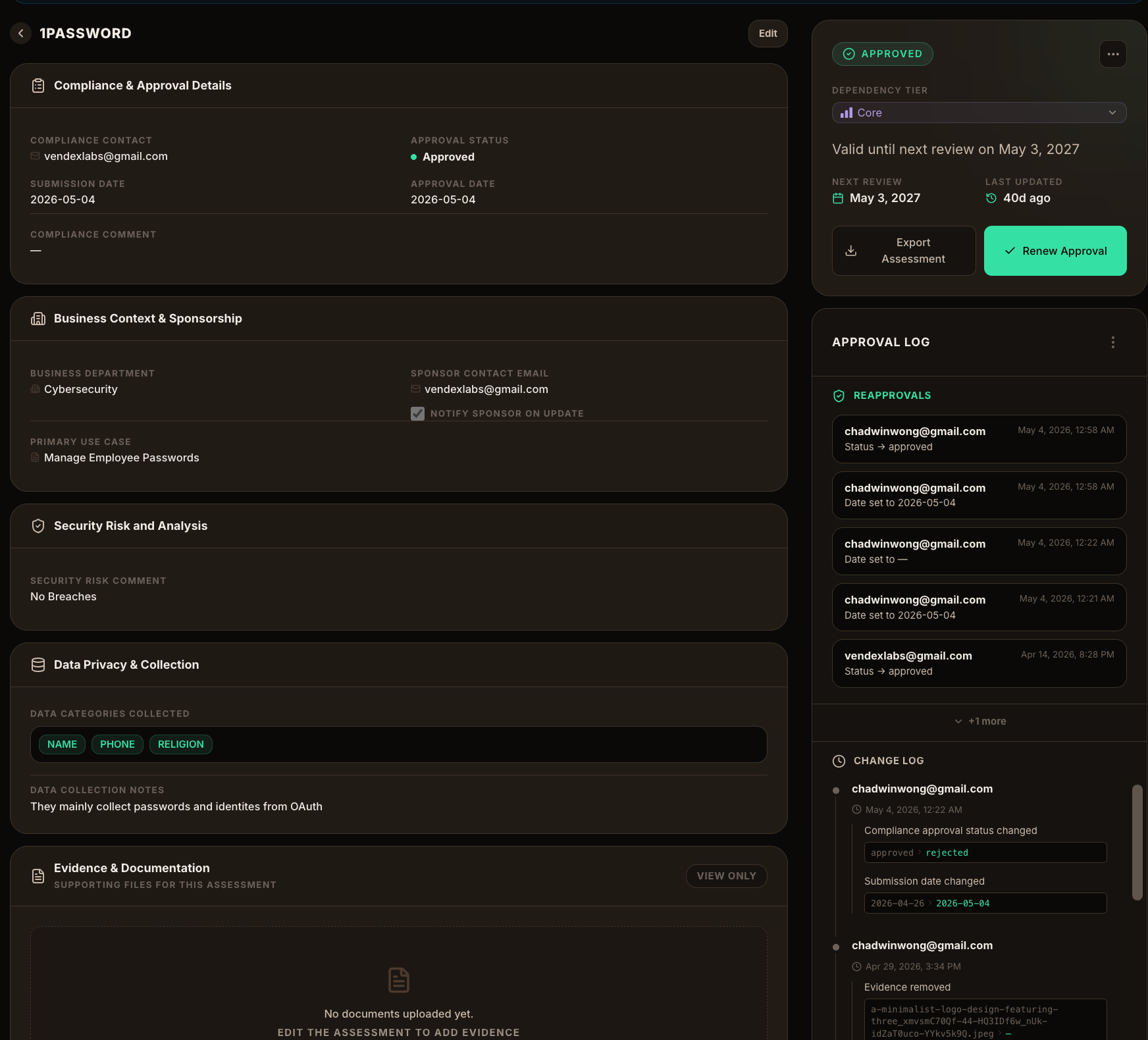
What an assessment captures
Compliance & approval
Compliance & approval
The approval status, compliance contact, submission and approval dates, and free-text compliance notes. For conditional approvals, the specific condition that must be met.
Business context & sponsorship
Business context & sponsorship
The sponsoring department, the internal sponsor’s contact, whether to notify the sponsor on updates, and the primary use case for the vendor.
Security risk & analysis
Security risk & analysis
Notes on the vendor’s security posture as it applies to your usage.
Data privacy & collection
Data privacy & collection
The categories of data the vendor collects (e.g. name, phone), plus notes on how that data is handled.
Evidence & documentation
Evidence & documentation
Supporting files — questionnaires, reports, certifications — attached to the assessment.
Approval statuses
An assessment moves through a clear lifecycle. The status is visible everywhere the vendor appears — the vendor grid, the assessments inbox, and the dashboard.| Status | Meaning |
|---|---|
| Not Started | No review has begun. |
| In Progress | Review is underway. |
| On Hold | Paused, waiting on information or a decision. |
| Conditional Approval | Approved, subject to a stated condition. |
| Approved | Cleared for use. |
| Rejected | Not approved for use. |

The audit log
Every save on an assessment records who changed what and when. Related field changes from a single save are grouped into one event, so the approval log reads as a clear history of decisions — reapprovals, status changes, date changes, and evidence added or removed. This is what makes an assessment defensible in an audit.Approvals are point-in-time. Assessments carry a review date, and VendexLabs surfaces upcoming expirations so approvals don’t silently go stale. Renewing an approval is a first-class action on the vendor’s assessment.
Assessments and monitoring work together
An approval reflects what you knew at review time. If a vendor is later involved in a breach or vulnerability, Recent Events surfaces it so you can re-open the assessment and reconsider — turning a static approval into continuous oversight.Run an assessment
Step-by-step: record a decision and attach evidence.