> ## Documentation Index
> Fetch the complete documentation index at: https://docs.vendexlabs.com/llms.txt
> Use this file to discover all available pages before exploring further.
# Risk scoring
> How VendexLabs produces a vendor's aggregate score, risk tier, and recommendation.
Every vendor gets a **risk posture**: an aggregate score, a breakdown across five trust domains, an integration-depth adjustment, and a recommendation. This page explains exactly how each is produced, so you can read — and defend — the numbers.
 ## Two steps: evidence, then a deterministic rollup
Scores are produced in two stages:
1. **Research-backed domain points** are gathered from public sources for each of five trust domains by [agent-based research](/concepts/enrichment), with the evidence cited so you can trace any figure to its source.
2. A **deterministic rollup** in our systems sums those points, applies the integration-depth adjustment, and runs guardrail ("floor") rules to arrive at a recommendation. Because the rollup is deterministic, the same evidence always yields the same score.
The headline number on the assessment is the **aggregate** — the sum of the domain points. Higher is better: it measures *strength of posture*, not "risk level."
## 1. The aggregate score (0–100)
The aggregate is the sum of points from five domains, each capped at its own maximum:
| Domain | Max points | What it covers |
| ------------------------------ | ---------- | --------------------------------------------------------- |
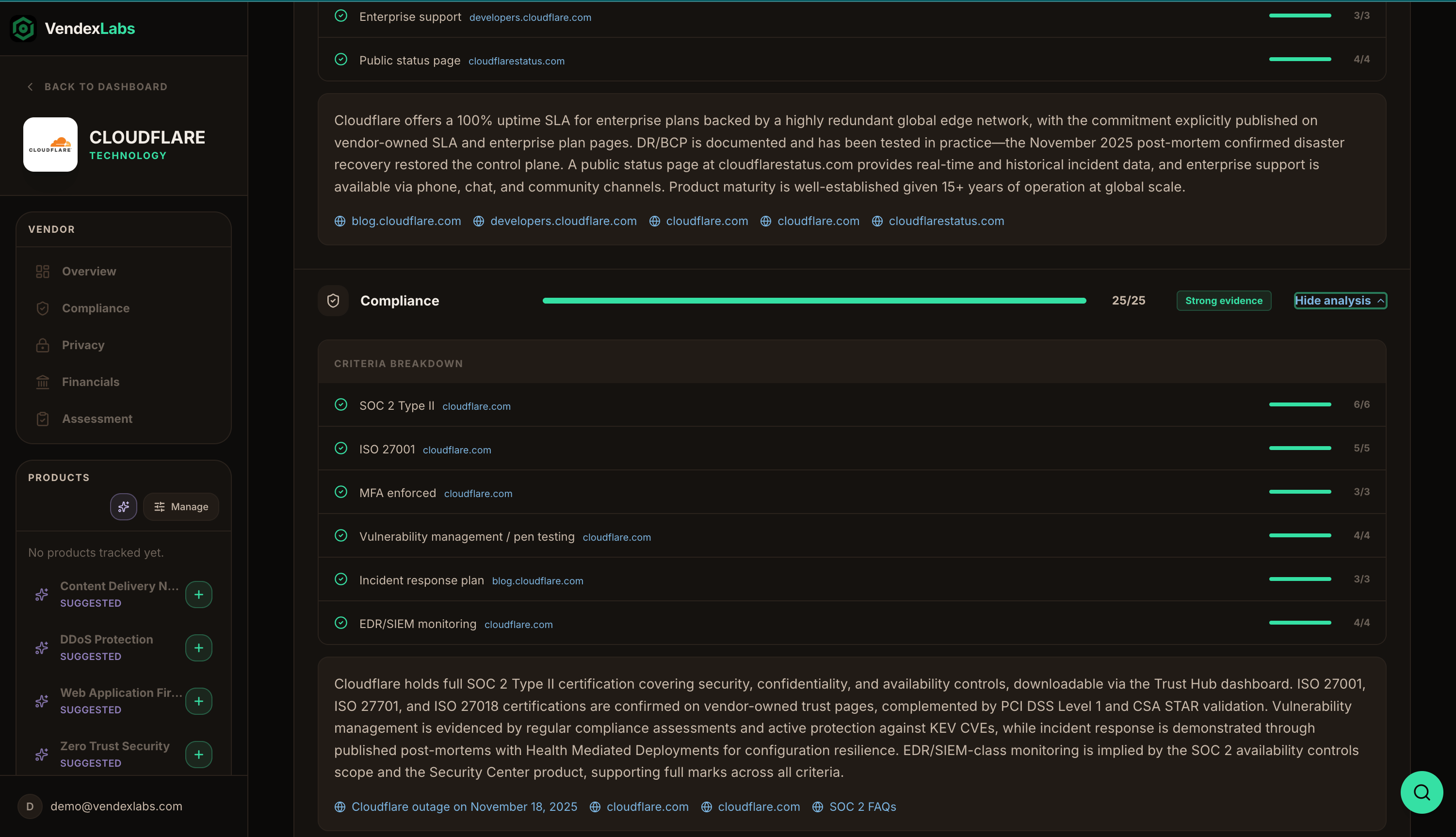
| Compliance | 25 | Certifications, frameworks, and security program maturity |
| Privacy | 20 | Data handling, privacy controls, and data-subject rights |
| Breach & threat track record | 20 | Known breaches, incidents, and threat exposure |
| Operational maturity | 20 | Reliability, scale, uptime, and business continuity |
| Business & financial stability | 15 | Funding, longevity, and financial health |
| **Total** | **100** | |
Each domain row on the vendor's **GRC Posture** tab shows its share of the total, along with an **evidence badge** (for example, *Strong evidence* or *Moderate evidence*). Badges describe the model's **confidence in the evidence** — they are not a separate risk score.
## 2. Integration depth
**Integration depth** describes how deeply the vendor sits in *your* environment. It doesn't change the aggregate score, but it does feed the recommendation — deeper integration means the same public evidence warrants stricter guidance.
| Integration depth | Meaning | Effect |
| ----------------- | ------------------------------------------------------------------ | --------------------- |
| Deep | Infrastructure-level access (cloud APIs, Kubernetes, IAM, network) | ×0.85 |
| Moderate | Sensitive business data, typical SaaS | ×1.0 |
| Light | Read-only or little sensitive data | ×1.10 (capped at 100) |
Integration depth is distinct from [dependency tier](/concepts/dependency-tiers). Tier weights your **portfolio** posture; integration depth sharpens a single vendor's **recommendation**.
## 3. Recommendation and floor rules
After domain scoring, **floor rules** may tighten the guidance when specific signals appear — for example, a weak score in a critical domain, a serious breach-history signal, deep integration combined with a low overall posture, or an active [CISA KEV](https://www.cisa.gov/known-exploited-vulnerabilities-catalog) match. Floor rules affect the recommendation only; they do not change the aggregate total.
The **recommendation** summarizes the outcome after those rules and reflects the score, the integration depth, and any escalations:
Posture and context support approval.
Approvable with conditions or compensating controls.
Evidence or floor rules argue against approval.
## Score history
VendexLabs snapshots each vendor's aggregate monthly, so the **Monthly Score Trend** on the vendor page — and the portfolio trend on your dashboard — show how posture moves over time rather than just where it stands today.
The recommendation is guidance, not a verdict. The final call is yours, and you record it as an [assessment](/concepts/assessments) approval status.
## Two steps: evidence, then a deterministic rollup
Scores are produced in two stages:
1. **Research-backed domain points** are gathered from public sources for each of five trust domains by [agent-based research](/concepts/enrichment), with the evidence cited so you can trace any figure to its source.
2. A **deterministic rollup** in our systems sums those points, applies the integration-depth adjustment, and runs guardrail ("floor") rules to arrive at a recommendation. Because the rollup is deterministic, the same evidence always yields the same score.
The headline number on the assessment is the **aggregate** — the sum of the domain points. Higher is better: it measures *strength of posture*, not "risk level."
## 1. The aggregate score (0–100)
The aggregate is the sum of points from five domains, each capped at its own maximum:
| Domain | Max points | What it covers |
| ------------------------------ | ---------- | --------------------------------------------------------- |
| Compliance | 25 | Certifications, frameworks, and security program maturity |
| Privacy | 20 | Data handling, privacy controls, and data-subject rights |
| Breach & threat track record | 20 | Known breaches, incidents, and threat exposure |
| Operational maturity | 20 | Reliability, scale, uptime, and business continuity |
| Business & financial stability | 15 | Funding, longevity, and financial health |
| **Total** | **100** | |
Each domain row on the vendor's **GRC Posture** tab shows its share of the total, along with an **evidence badge** (for example, *Strong evidence* or *Moderate evidence*). Badges describe the model's **confidence in the evidence** — they are not a separate risk score.
## 2. Integration depth
**Integration depth** describes how deeply the vendor sits in *your* environment. It doesn't change the aggregate score, but it does feed the recommendation — deeper integration means the same public evidence warrants stricter guidance.
| Integration depth | Meaning | Effect |
| ----------------- | ------------------------------------------------------------------ | --------------------- |
| Deep | Infrastructure-level access (cloud APIs, Kubernetes, IAM, network) | ×0.85 |
| Moderate | Sensitive business data, typical SaaS | ×1.0 |
| Light | Read-only or little sensitive data | ×1.10 (capped at 100) |
Integration depth is distinct from [dependency tier](/concepts/dependency-tiers). Tier weights your **portfolio** posture; integration depth sharpens a single vendor's **recommendation**.
## 3. Recommendation and floor rules
After domain scoring, **floor rules** may tighten the guidance when specific signals appear — for example, a weak score in a critical domain, a serious breach-history signal, deep integration combined with a low overall posture, or an active [CISA KEV](https://www.cisa.gov/known-exploited-vulnerabilities-catalog) match. Floor rules affect the recommendation only; they do not change the aggregate total.
The **recommendation** summarizes the outcome after those rules and reflects the score, the integration depth, and any escalations:
Posture and context support approval.
Approvable with conditions or compensating controls.
Evidence or floor rules argue against approval.
## Score history
VendexLabs snapshots each vendor's aggregate monthly, so the **Monthly Score Trend** on the vendor page — and the portfolio trend on your dashboard — show how posture moves over time rather than just where it stands today.
The recommendation is guidance, not a verdict. The final call is yours, and you record it as an [assessment](/concepts/assessments) approval status.